back to blog

Planning Your App

How to improve your app's user retention rates

By Tobin Harris

Managing Director, Pocketworks

Date: June 10, 2026

Updated: July 9, 2026

Reading Time: 10 Minutes

Getting people to use your app is almost as hard as getting people to download it. With AI making building much easier, this problem is more visible than ever. This article explores why improving retention is one of the most worthy uses of your time and money, and how you can do it. 

Retention is a biproduct of every app decision you have made so far, so figuring out how to fix it can feel slightly overwhelming. At the end of the day, if people don't come back to your app, you'll have a whole bunch headaches. You might see lower subscription revenue, higher churn, fewer bookings or even negative press. 

Hopefully, this article will give you food for thought. I've drawn on my experience gained at Pocketworks, where we have developed, operated and grown apps since 2012. We're both a developer and venture partner, and our our portfolio has generated hundreds of millions of revenue in the past 2 years alone. Retention rates are a huge part of that. 

Let's start with a high level view.

Where retention fits into your mobile strategy

If you've published an app, you know there are so many things to get right; from roadmap prioritisation and user experience to paywall optimisation, product analytics and your app store pages. The list goes on...

So where does retention fit in? Well, it's the sum of many parts, including all the above aspects of your app, and more. Figuring out how to improve retention can be a bit overhwelming. Where do you start? Do you even have a retention problem? Or does it lie elsewhere?

One thing that might help is to look at it through a certain lens. My recommend is a tool called Pirate Metrics. It helps you consider your app retention and how it relates to aspects of your app. You can dig deper on pirate metrics in another blog post, but for new let's just assume that your app customers pass through a virtuous cycle that looks a bit like this:

  1. You acquire users, usually through marketing
  2. They are "Activated", meaning they have an "aha moment" and understand your value to them
  3. You retain them, keeping them coming back (the subject of this article)
  4. You also generate some revenue from them, because they think your value is worth paying for
  5. You also delight people - your app is so good they refer it to other people, helping drive more acquisition (viral apps do this incredibly well)
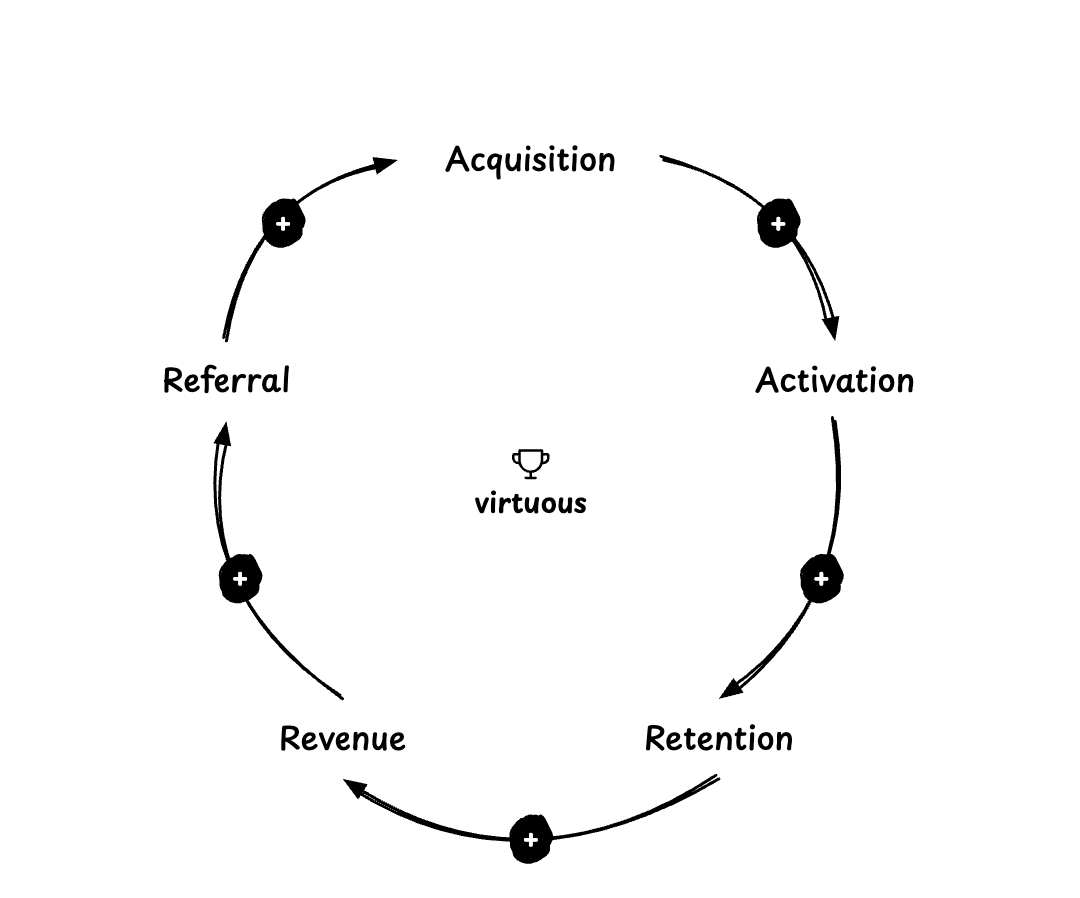
The above diagram shows Pirate Metrics as a cause-and-effect loop.

Any weak link in the chain will negatively affect your success. Are you offering a poor user experience? You're referals will drop, bringing fewer new customers. Struggling to activate customers so they "get it"? There's very little chance they be retained.  

It's worth asking yourself, do you even have a retention problem? Retention is downstream of acquisition and activation, could your real problems lie there? 

We'll cover this more shortly. For now, I'll assume you DO have a retention problem, so let's look at the high level ways to address it.

Four ways to improve retention

Here's three things I've noticed that make an impact to your retention. 

  1. Attract the right customers
  2. Offer more value to your users (better features or service)
  3. Design for retention
  4. Use retention hacks (tricks to keep people coming back)

I suspect you are here to learn about retention hacks. After all, you just want to do stuff that gets more people to come back. As you'll see, that's important, but so are the first two elements. 

The first one is the importance of attracting the right app users in the first place.

Attract the right customers

Lucy Beldon (our Mobile Growth Manager) has been running various advertising campaigns for apps on Google, Meta and the app stores. One thing she notices is that different adverts get different results when it comes to retention. 

For example, we ran one advert for Carbs & Cals that targetted XXX people who really need and want the app. Those users are likely to keep coming back, spend money, and really appreciate the app.

Why is this? Well, it's all about alignment between what the users need, how much they need it, and how well the app serves those needs. 

An exaggerated example would be to run an advert for your GLP-1 app, but only target people who do a lot of sports. It's unlikely this audience is the one that needs your app, so your not going to get great retention from this campaign.

One might argue that retention is also a marketing problem. It's about what you say and who you say it to and where you say it. And that goes beyond just running effective advertising campaigns. Your app store pages, copy, artwork, blog posts, newsletter, website and app onbaording screens all play a role in attracting the right audience so that you can retain them.

So, ask yourself this: are the people you attract to your app the ones most likely to get maximum value from it? Getting the right users will help you increase your retention.

Speaking of value, let's move on to how you can provide value to customers to increase your retention rates.

Give more value to customers 

There's no point spending loads of energy on attracting the right users if your app is funamentally not doing its job very well. In other words, not giving customers much value.

Customer value is a technology concern and a business concern. In the world of apps and digital products, the customer value is the product of several forces that all come together to drive retention: 

  • Marketing fit: are you bringing people that actually want what you offer?
  • Features: are you providing enough utility?
  • User experience: Is it convenient and easy?
  • Business operations: Can you provide adequate product, service and support?

For example, if you're a nutritional info app like Carbs & Cals, users will come back to the app more often if they can lookup any foods nutritional data, and the experience of doing that is nice and slick. UX matters here.

Or, if you're a taxi company like Veezu, people will come back to book more often if the cab arrives on time, is clean, and they don't get ripped off on price. Of course, the user experience has to good, and the app must have enough features to allow them to get the job done. 

Here's a quick summary of what value looks like to users.
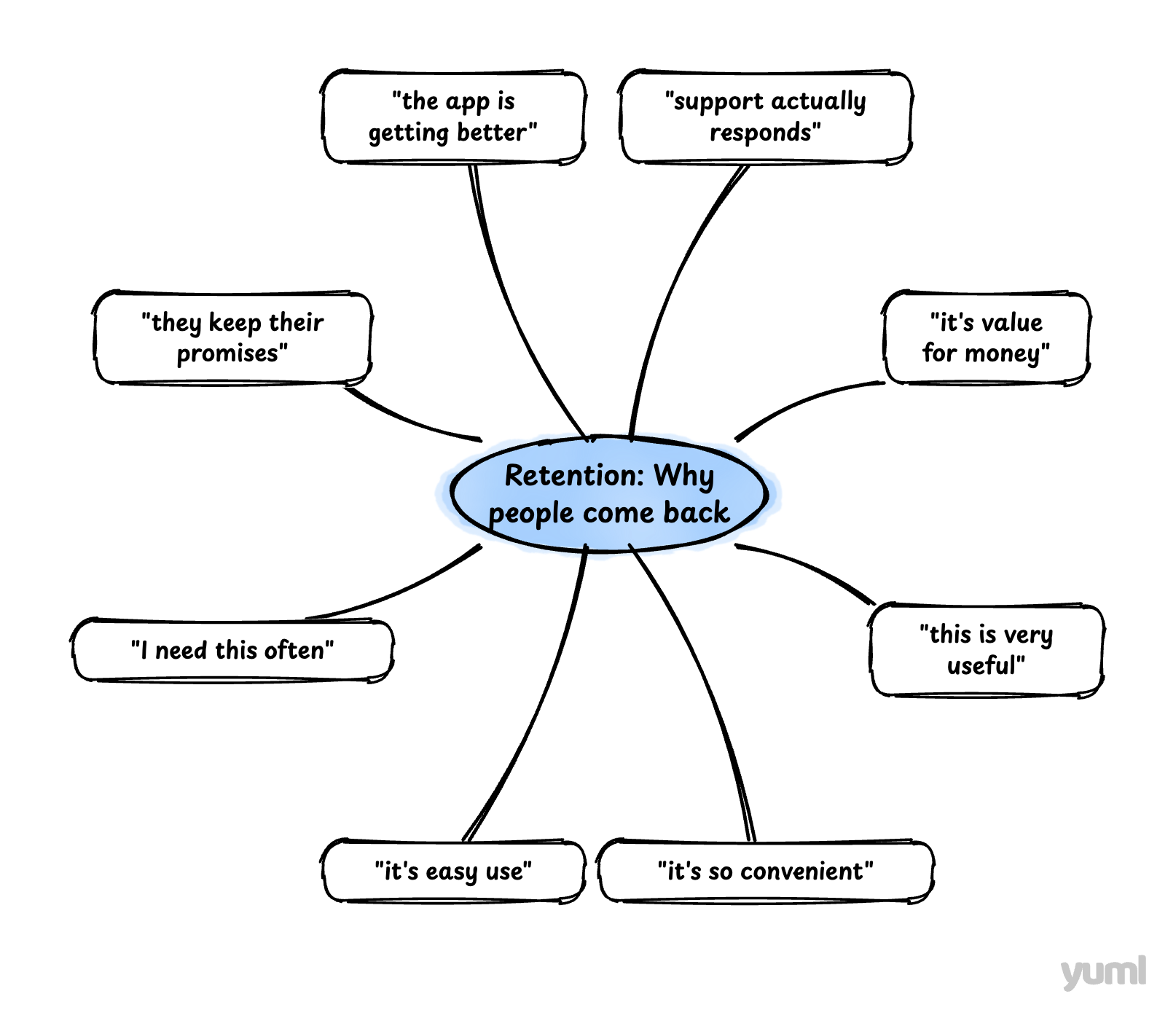
So, if you want to improve retention, you would do well to start by questioning your product and service quality. Or, in other words, what do people like, and what don't they like about your offering?

In case you're wondering, a good way to understand what customers think is through user research. You can do it guerilla style by analysing your reviews or customer service desk tickets. Or, you could hire a company like Pocketworks to do an in-depth survey and user interviews. It's pretty inexpensive and can be done in a few weeks.

If you're 100% sure your value is there and customers love your core offering, then perhaps you need to check you're actually designing for retention. Let's quickly look at that.
Oh, a quick interruption! If you like this article, you'll probably like our newsletter? It brings you loads of useful mobile insights and tips, helping you increase your mobile knowledge every two weeks 👇

Get inspiration from the world of apps.

We'll email you with updates no more than twice a month. You can unsubscribe at any time.

Righty, now that you've signed up, let's get back to the article 😅

Design for retention

If you've got this nailed, then it won't do you any harm to try some retention hacks that help chip away at your retention goals. Let's look at those.

Some retention hacks to consider

Retention hacks are good for handling our natural tendency to forget. So many of them are like reminders.

Your customers are human, and therefore they often simply forget your app exists. For example, they might hear about your app whilst chatting to friends in the cafe, then install it, and then get distracted by the waiter delivering their food. 

So, there are things you can do to keep them engaged, such as a push message on day-one that reminds them to use the app. Or an educational email drip campaign. Or a remarketing campaign on Meta. 

I call these hacks because they're working trying to improve retention by doing things outside of the core value of your app. 

  • Education, the easily overlooked superstar
  • Win-back campaigns
  • Pyschological manipulation (kind of)
  • Remarketing campaigns

I'll start with education, because it could be a quick win for you.

Hack: Improving retention through usage education

In January 2026, we completed a user research round where we surveyed 98 people who use an app to manage their Type 2 diabetes. 92% revealed that, during the interview, they learned about features they didn't know existed. 

What's the lesson here? If people don't know a feature exists, they won't use it, and they certainly won't come back to use it. Therefore, sImply educating people about features will drive up your retention.

Fortunately, there's a lot you can do to educate people about features. 

What we're doing for this particular app, an what you could do:

  • App store artwork communicates features
  • App store description communicates features
  • What's New banner on the home page promoting updates and new features
  • Tooltips for first time users explaining features
  • Push campaigns to people who don't come back after day 1 and day 3 or month 3
  • In-app messages to promote features to people that don't use them
  • Newsletter that talks about features

We're not perfect, so there are somethings we're not doing that we could be. Again, you could do this to drive up feature awareness, too.

  • Using onboarding screens to educate people about features
  • Creating a progressive onboarding todo list where people are asked to complete tasks to prove they understand the app
  • Analysing user behaviours and cross-selling features to users who do X but don't use feature Y
  • Every new user gets on an education drip campaign
  • Personalised in-app promotions encouraging people to use features that might benefit them

Some of these activities are easier than others. I won't go into depth here, but check out our App Growth guide to learn more. 

Hack: Running educational and win-back campaigns

I once worked with Meg, a very smart growth manager for some very large apps. She advised me on setting up these kinds of campaigns to help drive retention. Essentially, they entail targetting people that came and then left, or those that haven't formed a habit of using your app yet. Some examples:

  • An daily email or push message every day or two during the first week after download.
  • If someone doesn't use your app for 4 weeks, put them into a win-back campaign to tell them about value.

According to our data, don't expect these to drive massive results. But you might see 0.5%-2% click throughs - enough to make a difference.

Figure out which type of retention matters the most

I had a chat with two founders today and asked "Six months after your app is live, what would "success" look like if were looking at the business dashboard?". One said that active users was the main thing, because it demonstrated the app was being adopted. The other said they'd like to see people coming back. Both of these are retention metrics.

In theory, this sounds simple. The problem is, once you get into the analytics tools like Amplitude, Google Analytics or PostHog, things start to get complicated. 

You've can track hourly and daily retention weekly retention, yearly retention. There are different types of retention.

I'd say, for starters just don't worry about it. Sod em!

Instead, let's pick one good one to worry about.

So you need to figure out 

Then there's subscription churn. 

It took me a long time to realise that it might not be worth worrying about all kinds of retention.

Does retention even matter to you?

I'd also make a point that retention might not be worth tracking. For example, we worked with the UK's 2nd largest ride-hail app for 13 years, the really important thing was repeat bookings. 

You're next action list for improving retention

Here's a bit of a summary of next actions for you.

Look to understand if you are attracting the right customers to your app. Are they the ones who will get the most value from it? 

Decide if the people you are attractiving are activation - having the "aha moment". If they don't activate, they won't be retained. You might not have a retention problem, after all.

Decide if your product and service quality are good enough to keep people coming back. Look at your reviews. Interview some customers.

Review your educational content (app store, push campaigns, newsletter, tooltips etc). Do people actually know about the features in your app? Remember our example where 92% of respondents didn't know certain features existed? That could be happening to you, and killing your retention because perceived value is lower.

Set up an educational campaign that gives a push message every other day for the first week, telling people about your features. 

Setup a win back campaign when people don't come back to your app for 4 weeks. 

Enjoy, and hit me up on LinkedIn or email if you'd like to chat about any of this.

If you're struggling for time on all this, Pocketworks can help you with our growth services, which can include retention audits, strategy shaping, and setting up and running campaigns for you.  

Making apps that make a difference

In case you're wondering, Pocketworks is a software consultancy that specialises in mobile apps.

We bring you expertise in user research, mobile technology and app growth tactics to help you develop apps that create positive impact for your customers, shareholders and society.

To get a flavour of us, check out our free guides and app development services. Or, see some more background info on us.

Building an app?

We’ve got you covered.

pocketworks_mockup_mobilematuritychecklist
Explore our free resources