If you've spent any time researching app development or digital product development, you'll have heard the term Minimal Viable Product (MVP). But how does this differ to a regular full product launch? And is it the right solution for you?
Let's dig in.
The quick answer (I know you're busy!)
An MVP is a lower-effort version of your idea with deliberate compromises compared to a full product launch.
This is as-per the original definition of an Minimal Viable Product, which asks us to make something as small as it can be to get customers to buy.
So an MVP is a high quality verison of an app you'd launch and expect to get revenue from. However, it differs because it has more compromises than a full product launch, and therefore reduces cost and time to market.
A few of those compromises:
- An MVP has a feature set that is as small as possible whilst still making a customer want to buy it (it's viable).
- An MVP should have a quality user experience, but some areas might be rough around the edges. A full product launch would typically offer more finesse across the board.
- An MVP might not be ready for large scale, it might not be fully accessible, and security might be good rather than great. A full product launch might have reached a higher bar in all these areas.
- An MVP isn't the cheapest path foward, but costs are moderate compared to a full product launch. Think 25%-50%.
- An MVP might scrimp on some of the standard app building blocks; deep linking, detailed analytics, personalised push message campaigns, A/B tests on paywalls, and so on. A full product launch would likely have these things.
Le't dig a little deeper, starting with an example.
A simple example of MVP vs Full Product Launch
Firstly, my apolologies for the example subject matter, we're a Yorkshire company, after all!
So, imagine this. You're the resident chef at Ginsters Pies, and you've come up with a new recipe. You think it's so delicious, it will double your sales revenue in 2026 and 2027.
You have to decide on your next step in getting this tasty idea to market. Which do you do?
Option 1: Make 50 pies. Then, over several weeks, invite 50 people to taste-test them, tweaking as you go. If they like them, they can order some in advance. This excecise costs about £5,000.
Option 2: Make 50,000 pies, complete with packaging, branding, manufacturing processes and tooling, distribution channels and deals. This all costs about £25,000.
The first option is a Minimal Viable Product. It's a complete, high quality pie. But distribution is small and targetted so you can test people like it before investing further. You could even make some money from it.
The second option is full product launch. It's also a complete, high quality pie. But it's also a high-scale, and a lot of energy has been put into other important aspects such as branding, packaging, full distribution, and scalability.
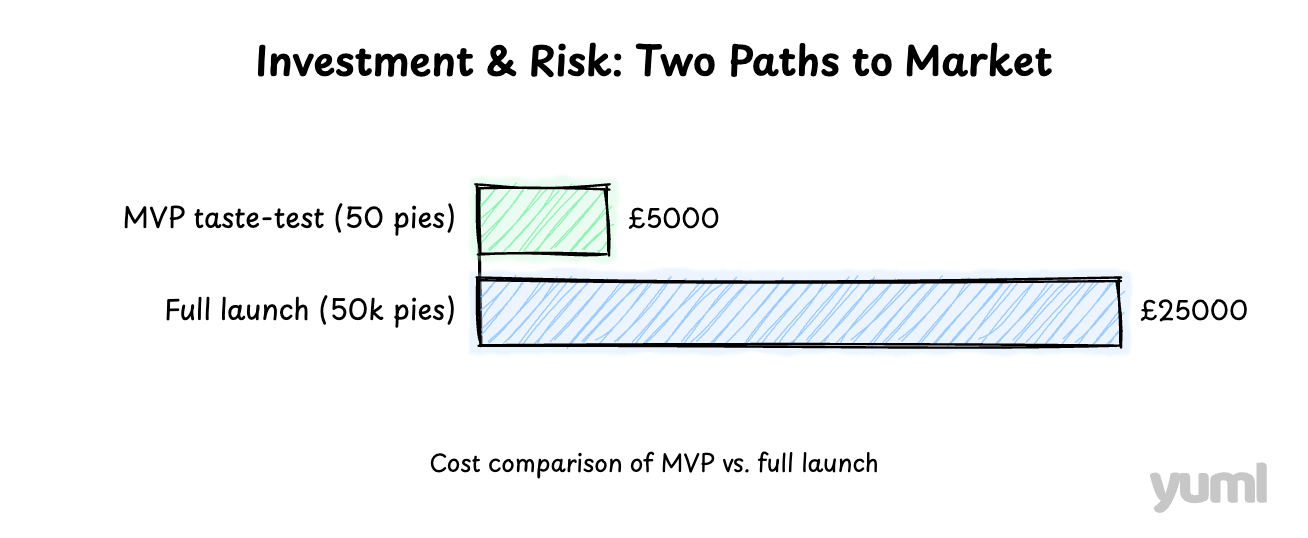
So, both result in a working product that is desireable, and even buyable. But one has a lot of compromises to reduce risk early on. After all, you don't want to package and make 50,000 pies if nobody will buy them. So, you might say, the MVP has a different purpose to the full product launch.
Let's look more closely at the differences.
The key differences between MVP and Full Product Launch
| Strategy Element |
MVP |
Full Product Launch |
| Primary Goal |
Make sure people will buy it. |
Maximise market share and revenue. |
| Feature Set |
Minimalist but complete core value. |
Exhaustive features, integrations and scalability. |
| Development Cost |
Low to moderate. |
Very high |
| Marketing Approach |
Direct sales / targeted beta. |
Mass marketing / public relations blitz. |
| Flexibility |
Easy to pivot based on feedback. |
Rigid; changes are costly after launch. |
The pie example might be useful as a taster, but it's more useful to talk about how an app MVP differs from a full product launch.
I've worked on over 50 app projects since 2008, and about 25% of those were, or at least should have been, MVPs.
Here's a few telltale signs you're taking the MVP approach with your app.
What you might observe during the app planning and development
| MVP |
Full Product Launch |
| You relentlessly try to build less. So your app won't have all the features your competitors have. But it has the differentiating ones. You're giving someone a good experience in the hope they will buy. |
You're focused on the needs of a large client base. You still have your differentiating features, but also all the other table-stakes stuff like accessibility, operational robustness, edge-case features etc. You will market to large volumes of people and want them to subscribe or buy. |
| Your MVP might have unacceptable compromises: minimal accssibility, so can't be easily used by people living with disabilities, vision impairment etc. |
For proper launch, you'll reduce those compromises to prevent large-scale support issues or even legal action. E.g. If WCAG AA accessible if required by target market. It usually is, and is also a legal requirement for apps sold into Europe. Also, you may want proper legal terms and policies, and check your GDPR. |
| Your MVP feels high quality in the places that matter, but some minor bugs might be permitted and visual quality might suffer in some areas. |
For full launch, you offer a high quality bar throughout; bugs are routinely elimited so not to generate support requests from high volumes of users. |
| Look and feel is professional, but might be changed before full product launch. |
Has a look & feel that mirrors the brand and incorporates customer feedback. |
If you've got this far you may have noticed that the MVP we're describing here is a quality product, not some experiment thrown together. It's worth noting that there are different definitions out there. Let's quickly cover those.
Oh, a quick interruption! If you like this article, you'll probably like our newsletter? It brings you loads of useful mobile insights and tips, helping you increase your mobile knowledge every two weeks 👇
Get inspiration from the world of apps.
Righty, now that you've signed up, let's get back to the article 😅
Isn't an MVP an experiment rather than a full product?
I appreciate the confusion here, because an MVP is often considered an experiment rather than a small "finished" app. However, for this article, we're using the original definition. As previously mentioned, there are actually two popular definitions for the term MVP.
Frank Robinson: MVP is a proper product (what we assume here): In 2001, Frank Robinson coined the term to define a proper sellable product that isn't bloated; enough to satisfy customers and generate revenue. So, in the world of apps, this is more like a quality product, with just enough to make it worth buying. Some people call this a Minimum Lovable Product.
Eric Reiss: MVP is an experiment (a very popular definition): In 2009, Eric Reiss published The Lean Startup book, and considered An experiment that helps you test an idea quickly and cheaply. In the world of apps, this is more like a vibe-coded prototype to show customers for feedback, or even a simple landing page with a lead capture form. Anything to test some aspect of your idea.
It's worth looking at the Eric Reiss definition, because it hits on something very important; an MVP might be actually too big for where you're at in your app business journey.
Why an MVP might be too big for where you're at
You might want to skip the MVP for now, and forget about a full product launch. This is because there's a much cheaper way to reduce risk for your app ideas. It's called a Validation Test, or an Experiment.
Remember the pie example? Well, what if you (the chef) simply grab 5-10 people from around your company to try your pies before taking out to a wider audience as an MVP? He or she could learn so much from these taste tests, and the costs would be tiny in comparison.
Heck, you could even ask people to taste-test a small batch of the sauce, and skip making a full pie. If the sauce is good, then consider testing the full pie next. This might save more time and money.
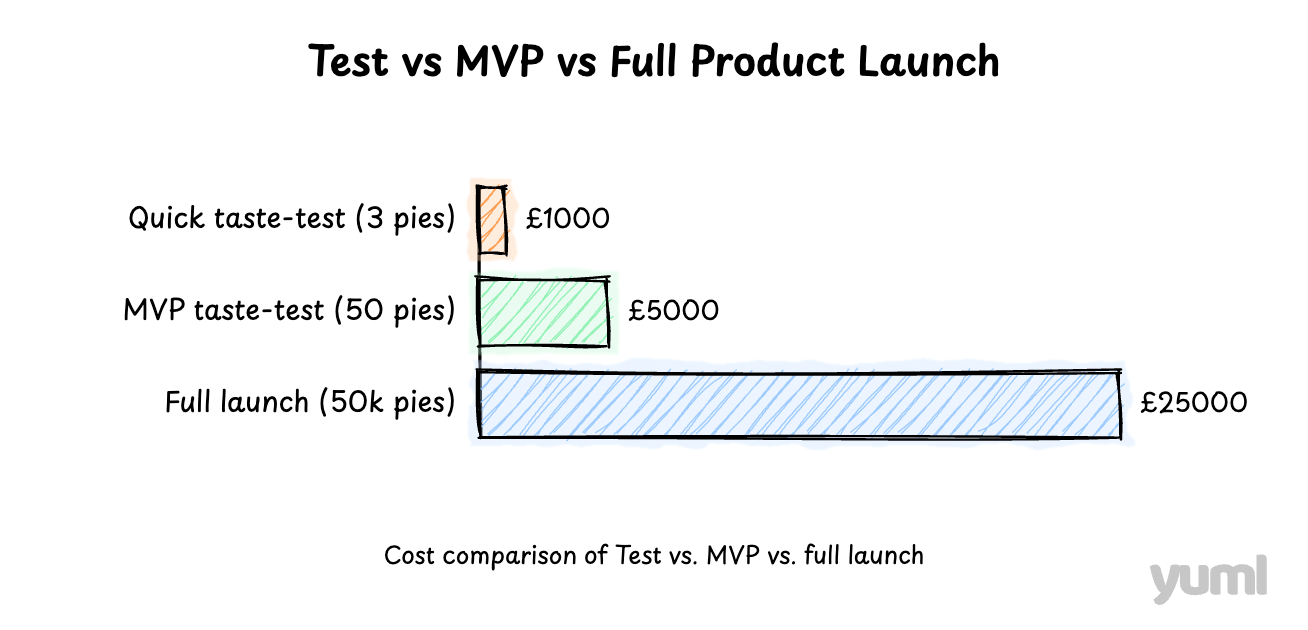
To put this in context, I've worked on at least five apps that were developed as a moderately expensive MVP when really a series of small tests would have revealed more useful information, and would have been far less expensive.
I recall one founder spending almost £1m on a venture that he was so confident in, but he didn't want us to do any tests or experiments. In his own words:
I was living in an echo chamber
-- Founder
We laugh about it now (just about!). For context, he's a really smart guy and a huge visionary, but he was hearing so much positive feedback from peers and investors he didn't think to run small tests on his target audience.
It's really tempting to build the whole vision, but often what you reallly need to do is build just enough to learn. And, as I'll explore below, that might mean not building an app at all.
So how not to blow £1m, or even £100K?
Eric Reiss promotes doing experiments to reduce risks. As mentioned above, his definition of an MVP is a small test to help you validate you're on the right tracks.
For example, rather than spend a moderate amount of money on an MVP, you could invest in a test. Which might be:
- An unbiased survey to your target audience
- A series of user interviews
- A landing page with waiting list sign up
- An explainer video, where you measure engagement
- A Meta advert, seeing how many of your target audience click through
- A vibe coded prototype given to 5 people to use for a week
You can learn so much from these things, and many of cost a fraction of what you'd spend on MVP development.
If you're like most business leaders or founders, this will be totally alien to you. You'll just want to buil the MVP or full produt release. But I'd strongly encourage you to do small tests instead (and, shamelessly, we can help with that).
Let's next look at why it's a good idea.
When experiments beat an MVP
Why is running tests or experiments more important than an MVP?
Well, firstly because most apps are failing right now. A March 2026 MIT study showed that app releases are massively spiking, mostly because agentic AI is enabling anyone to create an app.
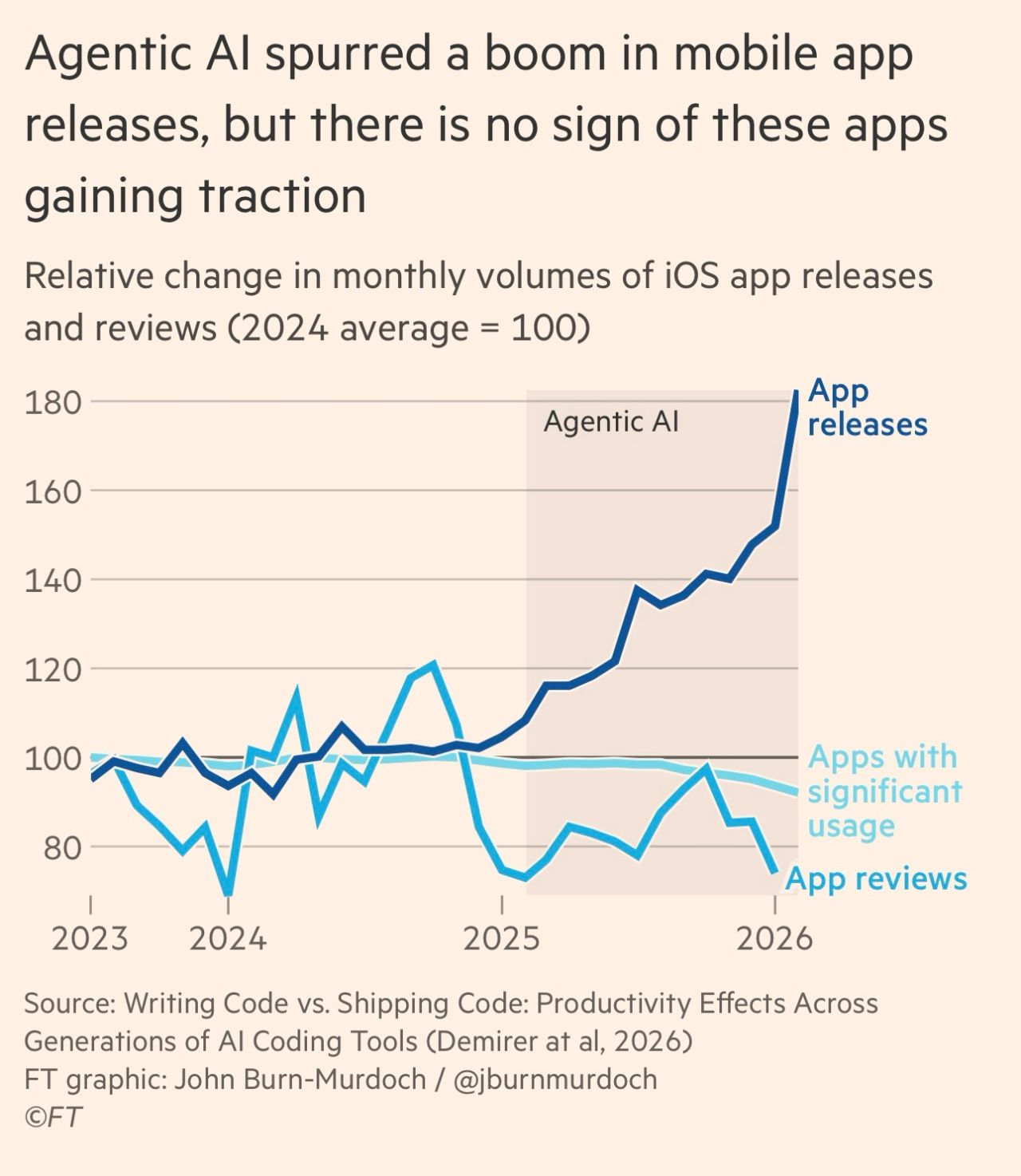
Because many of these apps aren't attracting downloads and repeat usage, app usage is dropping relatively - there are more apps but no corresponding increase in usage. The same goes for app reviews.
In fact, this has always been the case. Distribution has always been expensive - getting people to download your app. As Lucy here says, "App marketing is really tough right now" (good article if you care about app marketing).
On that theme, I started tracking calorie counting apps on my home grown app intelligence tool - Apportunity. I've got 748 apps tracked, and a whoppping 42% have a 1-star review. And the majority are struggling. As you can see from the diagram below, most are in the "low maturity, low traction" zone, meaning they are struggling to get users and generate revenue.
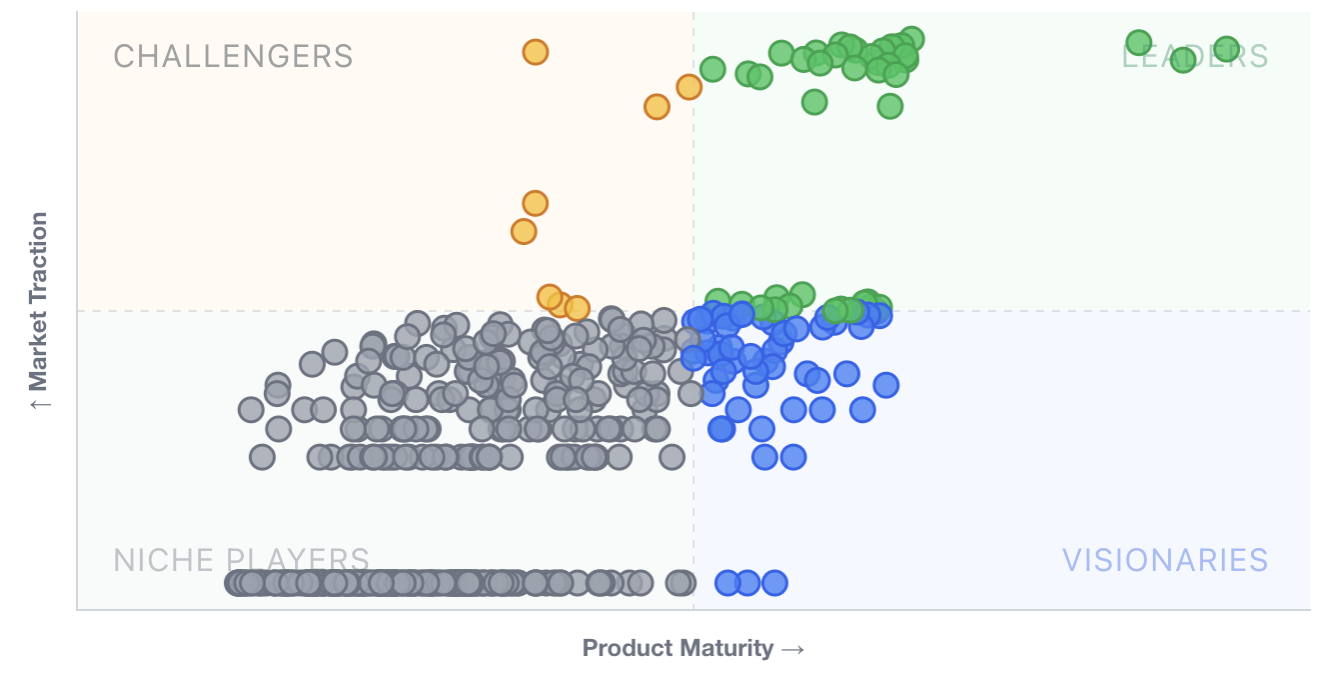
So, running experiments/tests can help you break out of this zone. Building is easy these days, but running experiments takes patience and skill.
Note that you don't have to do these experiments yourself, or pay big bucks to a market research agency. For example, at the time of writing, Pocketworks typically ask clients to budget £5K to test a bunch of ideas, or perhaps £25K to build prototypes, test them, iterate and narrow down exactly what your audience will respond to. Our "App, yes or no" service gives a flavour of what this looks like. Or, if you're looking to test who's most likely to buy or use your app, we could run some growth experiments purely on the market research side.
If you want more food for thought on how to reduce costs by running experiements, read on.
Where can I learn more about MVP vs full product development?
I wrote a guide called Badly Drawn Mobile. Many of the diagrams in there discuss how it's better to build less and test with the market. You can download it here - it should give your some great food for thought.
Enjoy!




 2025 Pocketworks Mobile Ltd